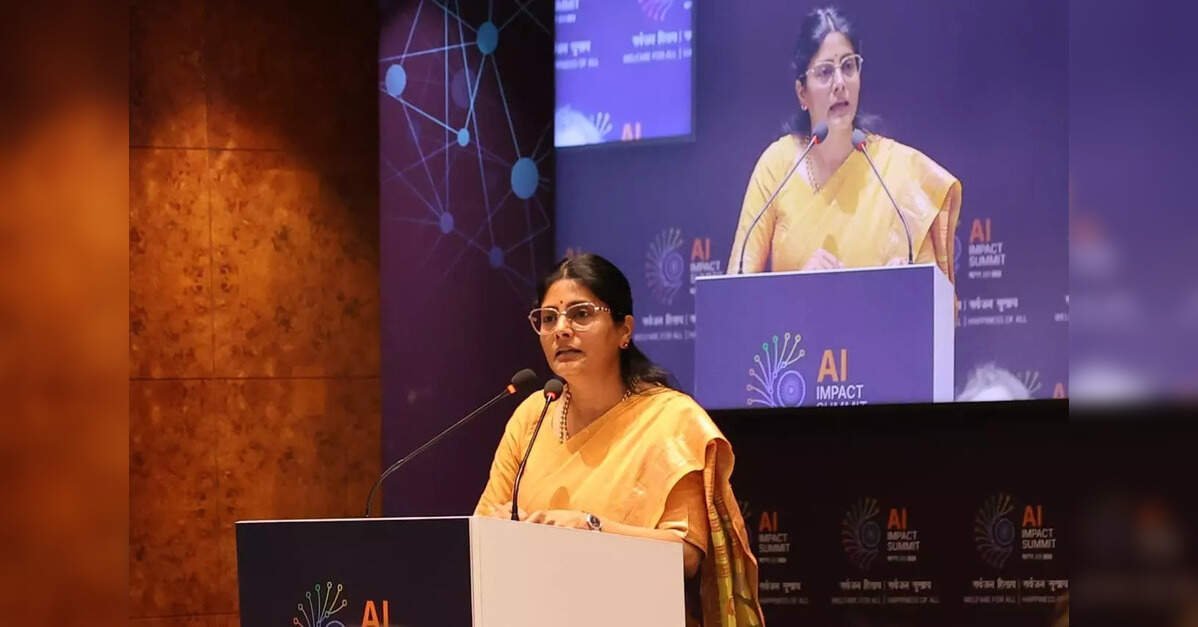
New Delhi: Union Minister of State for Health and Family Welfare Anupriya Patel today said that India’s approach to Artificial Intelligence (AI) in healthcare must prioritise inclusion and equity, describing it as “All-Inclusive Intelligence,” a vision aligned with Prime Minister Narendra Modi’s broader developmental agenda.
Speaking at a session titled “Innovation to Impact: AI as a Public Health Game-Changer” the minister highlighted AI’s growing role across the healthcare continuum from surveillance and prevention to diagnosis and treatment—especially as India works toward its Viksit Bharat 2047 vision.
Patel noted that India’s demographic scale, rural–urban disparities, and the dual burden of communicable and non-communicable diseases require technology-led solutions that are scalable and affordable. She pointed to the AI-enabled Media Disease Surveillance System, which tracks disease trends in 13 languages and generates real-time alerts to strengthen outbreak preparedness.
Under the One Health Mission, the Indian Council of Medical Research (ICMR) has introduced AI-based genomic surveillance tools capable of predicting zoonotic risks even before animal-to-human transmission, signalling a shift toward preventive public health.
The minister also highlighted AI-enabled handheld X-ray devices and computer-aided detection technologies for tuberculosis screening, which have contributed to a 16 per cent increase in case detection and improved treatment outcomes. She emphasised that such innovations must remain frugal, scalable, and accessible in resource-constrained settings.
To build capacity, Centres of Excellence for AI have been established at AIIMS Delhi, PGIMER Chandigarh, and AIIMS Rishikesh, integrating advanced analytics into public healthcare delivery. Additionally, the National Board of Examinations in Medical Sciences has launched an online AI training programme to equip doctors with digital competencies.
Patel clarified that AI is intended to assist—not replace—medical professionals. “Medicine is not only a science; it is also an art,” she said, stressing the enduring importance of empathy, clinical judgment, and human interaction.
Adding a policy perspective, VK Paul, Member (Health) at NITI Aayog, described AI as a strategic tool to accelerate universal health coverage through early diagnosis, stronger primary care, and data-driven policymaking. He called for robust regulatory frameworks, ethical safeguards, and sustained collaboration between government, academia, and industry.
From the industry standpoint, Roy Jakobs, CEO, Royal Philips, said,”AI’s greatest impact would be in healthcare but warned that its success depends on strong data governance, interoperability, and clinical integration. He emphasised that trust, transparency, and continuous validation are essential to ensure patient safety and clinician confidence.”
Speakers collectively agreed that AI must move beyond pilot initiatives to full system-level integration supported by interoperable digital infrastructure and quality datasets. The session concluded with a consensus that responsibly deployed AI can significantly enhance surveillance, diagnostics, and decision-making—while remaining a tool that strengthens, rather than substitutes, the clinician’s role.