

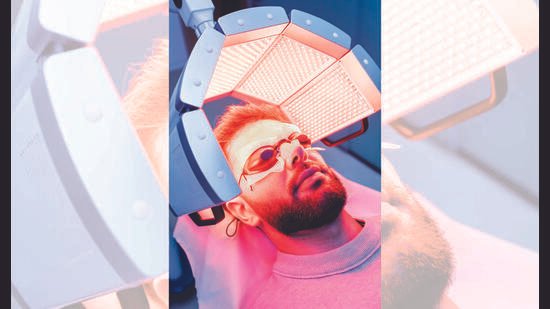
The kids are all right. They might just be a little too all right. While most grown-ups spent their 20s and 30s thinking they’re invincible (and focused on health only after their first sobering full-body check-up at age 40), 20-somethings today have it determinedly backwards. They’re tracking every metric early on, and experimenting with every short-cut that looks promising. Billionaires call it biohacking – the kids do too.
Abhishek Paul, 26, grew up playing sports and following a disciplined fitness routine. It worked until it didn’t. Pushing harder no longer showed gains. His gym progress plateaued even as work pressure intensified and burnout crept in. In any other generation, a 20-something would just let go. Paul however, paid closer attention to recovery, sleep and nutrition, and to how his body responded to stress. “Longevity isn’t about living forever,” he says. “It’s about staying active, strong and independent for as long as possible. I want my body to keep up with the life I’m building.” They grow up so fast, don’t they?
Early start
Being young is no picnic. Most graduates entering the workforce have already cleared high-pressure competitive exams, prepped for recruitment rounds, sat through endless interviews, to land jobs that demand more of them than they bargained for. So, when life’s treadmill is speeding up, and there’s unprecedented access to health data, young adults are hoping to manage their bodies long before they begin to break.
There’s plenty of assistance online. The Huberman Lab, the world’s most-streamed health podcast, counts India among its top listener bases. Google Trends for India shows a sustained growth through 2024-25 in searches for “biohacking”, “cold plunge”, “red light therapy”, “NMN India” (for Nicotinamide Mononucleotide, which is believed to slow ageing) and “intermittent fasting”. There are Reels for every routine, dashboards to compare progress, and 2x explainers on why you shouldn’t compare progress in the first place.
Dr Sajeev Nair, one of India’s early biohacking advocates, says the falling age of longevity seekers has more to do with familiarity than fear. Gen Z, he explains, has grown up surrounded by dashboards, metrics and constant feedback – in classrooms, offices and social lives. They naturally apply the same logic to their bodies. “Many have witnessed sudden health collapses among seemingly fit adults. They’re not risking it.”
Abhijeet Satani, neuroscience content creator, says it’s not uncommon for Indians in their early 20s to be “curious, data-driven and tracking sleep, glucose, recovery and stress.” That’s even more reason to not mistake optimisation for shortcuts. “Hype always arrives disguised as magic pills or magic diets,” Dr Nair says. The fundamentals – sleep, food and movement – haven’t changed, despite the dashboard updates.
Twists and turns
Goutami Chawla Talati, 30, struggled with acne so severe as a teen, it resisted dermatological treatment. She was also a dancer, constantly under stage lights and scrutiny. “It made me extremely self-conscious,” she says. So, when she made lifestyle changes that cleared up her skin at age 18, it was like a portal has been opened. “What shocked me was that my digestion improved too.” She began seeing the body as an interconnected system, one where routine and discipline were key drivers in restoring balance.
Mental health professionals see Gen Z’s fascination with biohacking not as a fixation on perfection, but as a psychological response to uncertainty. Can you blame them? They’ve lived through an economic downturn, a pandemic, a bot revolution and a life spent on screens. “When the external world feels unstable, the mind looks for areas where it can create certainty,” says Mumbai-based psychologist Dr Harshant Upadhyaya. Early engagement with health data isn’t such a bad idea. “Health routines provide predictability and can support emotional regulation when they are treated as skills, not rigid rules.”
For a generation raised on metrics, the real challenge may not be learning how to optimise, but knowing when to hit the brakes. Chawla Talati says that after years of tracking and routine-building, “wearables actually made me more anxious”. Recovery scores and stress markers began to dictate how she felt about her day before it even started. Even Paul relies less on data now. “It’s there to keep me mindful; not to control my life.” He focuses more on the cues his body sends out about hunger, pain, exhaustion and fear. Dr Sudheendra Rao NR, neuroscientist and scientific advisor at the Organisation for Rare Diseases India, warns that “the body doesn’t have a factory reset button”. “Without medical oversight, people may end up gambling with the long-term health they hoped to secure.”
