

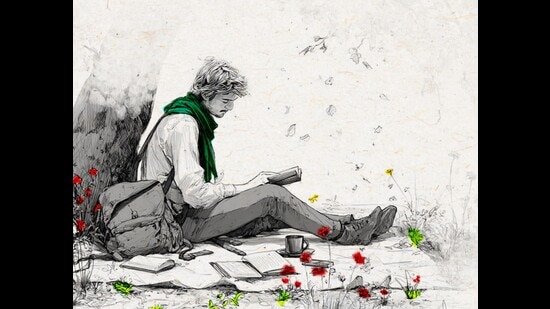
Growing up the only child of a single parent in Udaipur, Priyanka Sarkar remembers playing games she made up herself. As a young adult, she says, a “quiet ache” of isolation hovered at the margins of her life.
Then the pandemic hit. She spent two years in Gurugram, “a city of loneliness”, caring for an ailing uncle. “Loneliness, at this point, became an intense, inescapable feeling,” says Sarkar, 42.
Once the world opened up, she began working as an editorial consultant and translator with Sahitya Akademi in Delhi. But the echoes of this other, emptier world stayed with her.
Finally, in 2023, she approached the editor and translator Semeen Ali, then an editorial assistant at the Akademi, to ask if she would like to put together an anthology on loneliness.
The idea intrigued Ali, 41. “We’re conditioned to internalise these emotions rather than speak about or share them. I knew it would be a challenge, but an exciting one,” she says.
And so the two women found themselves inviting poets and writers to share their experiences of it. The result is Writing from the Solitary (Yoda Press and Simon & Schuster; December 2025): 23 stories, essays and poems, most of them written for the collection.
In The Muse Peeps into the Attic, International Booker Prize-winner Geetanjali Shree explores the emptiness and sense of surrender that sit at the heart of the act of writing.
In Annie Zaidi’s Nivvi’s Knees, the traumas of aging and isolation see a kind woman losing her grip and nearing desperation.
In The Pleasures of Solitude, Jeet Thayil and Nilanjana S Roy discuss how this state of being shaped legends such as Ismat Chughtai, Maya Angelou and Georges Simenon.
In Anil Menon’s short story The Kingdom, a professor, in a moment of idleness, imagines the alternate lives he could have led. Arunava Sinha’s translation of Kamal Chakraborty’s Maradona, meanwhile, explores the fragile loneliness that persists in the glare of public life.
“Our goal was to show that this emotion is rooted in the social, cultural and political,” says Ali. “It is shaped by the structures of the very world we live in.” Excerpts from an interview.
* What story stood out for you most, as you put the anthology together?
Priyanka Sarkar: Annie Zaidi’s Nivvi’s Knees resonated with me. What she writes about, I saw first-hand with my grandmother, Ava Rani Ghosh (who died aged 80, in 2015). Increasingly, she felt like she was losing “relevance” as she outgrew societal spaces. She had no one her age to speak to. No one with whom to share, without fear of judgment, the outrage she felt at the generational changes she witnessed.
Semeen Ali: It was surprising to me how distinctions around gender began to blur when we sat down to collate this anthology. Everyone feels loneliness, if differently.
* Has hyper-capitalism made us both more physically comfortable and more intensely lonely than people at any other point in history?
Ali: I do think we are lonelier today. If I look back at my childhood, growing up in the ’90s in the sleepy, close-knit city of Allahabad, we always found time to spend with people, to talk over the phone or visit each other. So what changed? One of the answers can be, and is, hyper-capitalism.
* Do you think that’s because we needed each other more; now we seem to need things, and feel less dependent on people?
Sarkar: All systems alienate someone to create themselves. A community is usually formed by excluding someone. Maybe now we are just making a better attempt to get their stories.
Ali: I think we still need a sense of community, but our need for privacy has grown. It wasn’t easily available to our parents’ generation, but we’ve got a chance to experience it, and now we are constantly seeking a balance.
* Which of the pieces surprised you most?
Ali: Perundevi’s micro-fiction, translated beautifully from the Tamil by N Kalyan Raman and titled Honey. It explores the delicate relationship between a woman and a chimpanzee in a zoo. A quiet kind of loneliness pervades the story.
* In the age of performative connection on social media, can solitude also be a form of rebellion?
Sarkar: Choosing solitude is always an act of rebellion.
Ali: To be able to go inwards and not be distressed by the silence has to be a rebellion of sorts. For silence is also one of the ways solitude is celebrated. Silence here is not a denial of voice; it becomes a source of strength.
