

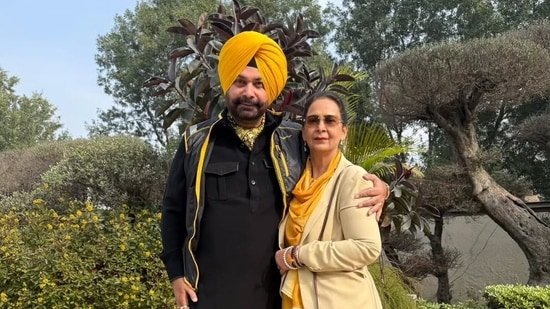
Navjot Kaur Sidhu, politician and wife of cricketer-turned-politician Navjot Singh Sidhu, ignited a debate after a video surfaced on January 31. In it, she admitted that apart from allopathic treatment, consuming cow urine (gomutra) and her diet, played a role in her health journey. She fought stage 4 breast cancer a few years ago. Also read | Navjot Singh Sidhu shares wife’s strict diet which helped her beat stage 4 cancer: ‘Started day with lemon water’
While the video has been widely shared, medical experts have debunked the claim about cow urine, warning that such ‘anecdotal’ evidence could prove fatal if followed by others.
The claim and the clarification
In the video posted by Acharya Aniruddhacharya on Instgaram, Navjot Kaur Sidhu was seen agreeing as he shared details of her cancer journey, stating that she was still drinking cow urine after she started having it regularly – and was even bathing in it – during her illness.
Take a look:
However, following a backlash and concerns regarding alleged medical misinformation, Navjot Kaur Sidhu took to X (formerly Twitter) on February 3 to clarify her stance. She shared that she does not advocate abandoning modern medicine.
She said, “See the full video. Allopathic treatment is the only cure once you have cancer. This was one second of half hour talk on supporting therapies helping people. You always do inclusive treatment because if you keep having sugar, refined oils, acidic products, preserved foods, grains, milk products, pesticide used food etc. you can never cure your illness. Lifestyle changes and food that you eat change your cells from inflammatory and malignant to normal cells. First basic treatment protocol by your oncologist. Half knowledge is very dangerous, full reel should be seen.”
She also shared on Instagram: “Only allopathic treatment by a cancer specialist will save your life. Alternative therapies like lifestyle changes, pesticide-free organic foods, no grains or milk products, cow urine therapies act as supportive therapy and can never treat you. Immediate treatment by a good doctor, like Dr Rupinder Batra, for me is very important and the only way forward for a cancer patient. Surgery, chemotherapy and radiation saved my life. Food and lifestyle changes were added to help me heal sooner and have prevented recurrence till date.”
Medical experts respond
Despite her clarification that cow urine was a ‘supportive therapy’, oncologists have expressed concern over the potential for such statements to mislead vulnerable patients. Speaking to HT Lifestyle, Dr Poovamma C U, lead and HOD of breast oncology at Aster CMI Hospital, Bengaluru, stressed that personal stories do not equate to medical proof.
“Doctors around the world agree that there is no scientific evidence to show that cow urine can cure breast cancer or any other form of cancer,” Dr Poovamma said, adding, “When public figures share such claims, it can confuse patients and families who are already scared. Some may feel pressured to try unproven remedies and delay proper treatment, which can reduce the chances of recovery.”
She reiterated that while faith and nutrition are supportive, they cannot replace surgery, chemotherapy, or radiation — treatments backed by years of clinical trials.
The danger of false hope
The sentiment was echoed by Dr Shishir Shetty, director of surgical oncology at Fortis Hiranandani Hospital, Navi Mumbai. He labelled the claims ‘scientifically incorrect and potentially dangerous’. Dr Shetty told HT Lifestyle: “The real danger of promoting such narratives is that they can give false hope, encourage patients to delay or abandon proven treatment, and ultimately cost lives. Oncology history is full of examples where unproven remedies caused harm when substituted for standard care.”
Dr Shetty noted that while patients often use traditional practices alongside their treatment, he urged public figures to be ‘especially careful’ with anecdotal claims on social media, as they carry the weight of influence over patients who may be desperate for a miracle.
While Navjot Kaur Sidhu maintained that her message was one of ‘inclusive treatment’ and holistic lifestyle changes, doctors remained firm: cancer remission is the result of evidence-based medical intervention. Oncologists urged anyone facing a cancer diagnosis to rely strictly on qualified oncologists and treatments backed by rigorous scientific data.
Note to readers: This article is for informational purposes only and not a substitute for professional medical advice. Always seek the advice of your doctor with any questions about a medical condition.
