

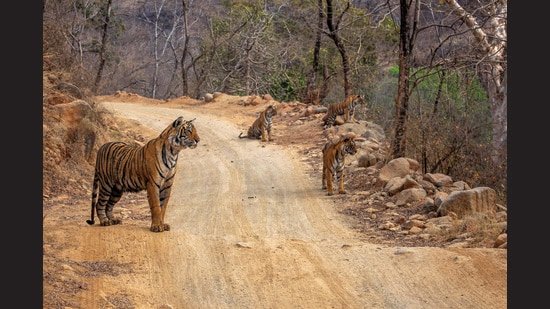
An exhibition at Bikaner House in Delhi, organised alongside the launch of the book, showcases photographs, historical maps and early wildlife records, paintings, video installations, and soundscapes recorded in the park.
.
Thapar began his field work at Rajasthan’s Ranthambore Tiger Reserve in 1976. Through decades of research and advocacy, he gave India’s Bengal tiger a voice, and fought to have its habitats protected. The tiger population has risen dramatically since that period, from an estimated 268 individuals to over 3,600 today.
.
Ranthambore was declared a national park in 1980. Today, it is an almost mythically beautiful landscape of big cats draped along fort walls and at temples, stalking through ruins, deciduous forests and dramatic brown rocky terrain. The reserve now sustains about 70 tigers, the highest this number has been in recorded history, and is one of the world’s best destinations for wild tiger viewings.
.
The photobook, Ranthambhore: Fifty Iconic Years, worked on by Thapar even in his last days (he died last May, aged 73), is a love letter to the national park. As word of the project spread, Thapar and Engineer received more than 5,000 submissions, from over 1,000 photographers. The final volume features 800 curated images from 130 photographers.
.
Departing from a standard chronological record, the volumes honour Thapar’s vision of the jungle as a place of constant discovery. “The book itself is structured like a series of spectacular safaris,” Engineer says, “where every turn of the page brings an unexpected surprise.”
