

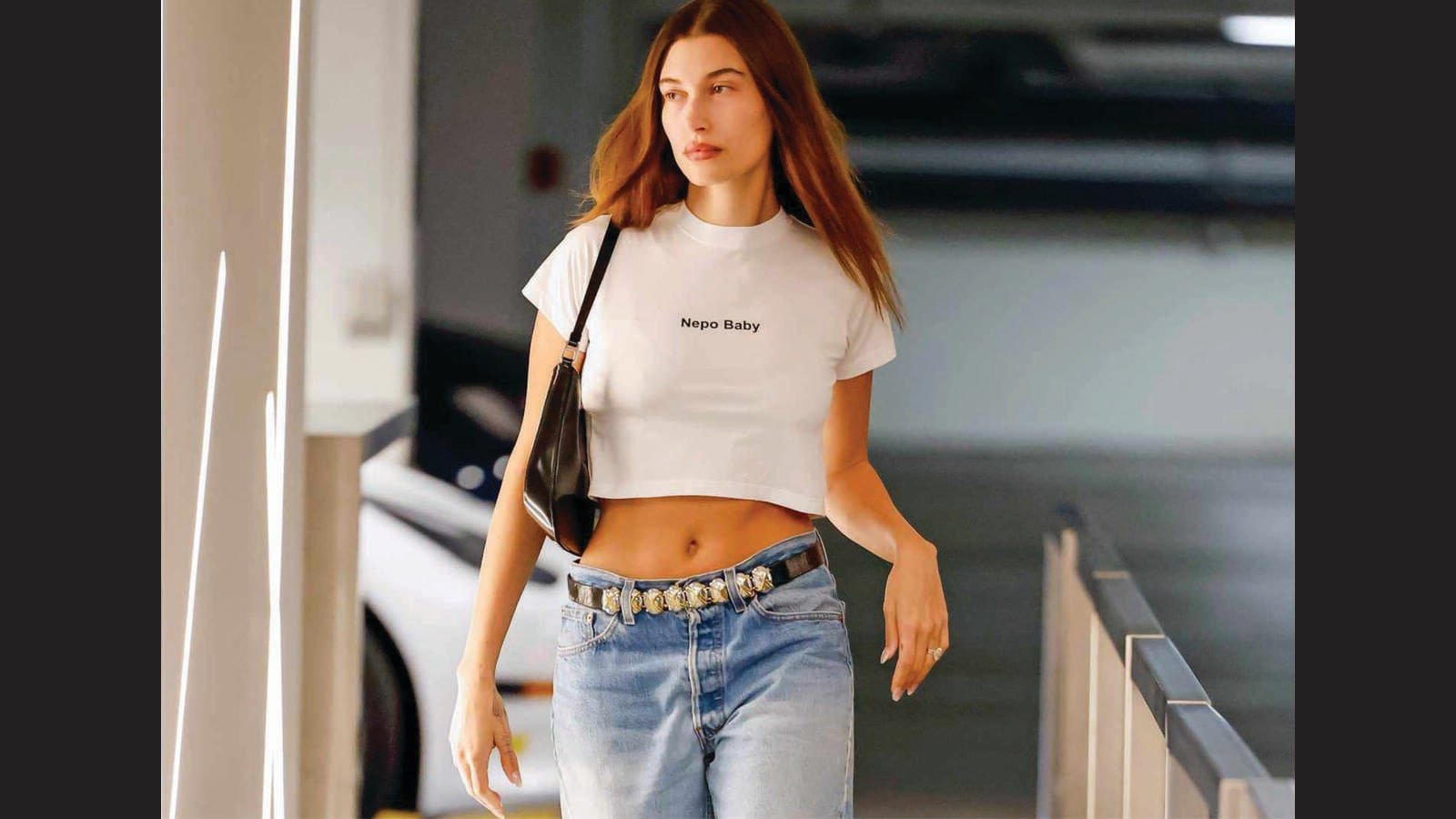
For years , it was all about jeans. The fit mattered. The label on the back meant everything. We obsessed over the right kind of blue, how high it rose, where it frayed, and where it faded. Now, jeans have been shoved to the back of the shop floor, they’re at the back of our minds. A long-ignored garment is front and centre: The T-shirt. And fashion is only part of the story.
It’s back as a symbol of activism. All this year, Pedro Pascal and other celebrities wore T-shirts that read Protect the Dolls, drawing attention to transpersons’ rights. It’s the IRL status message of our time. At IPL 2025, MS Dhoni wore a T-shirt bearing Morse Code that fans quickly translated to read One Last Time, suggesting that this might be his final season. It’s prime real-estate for a micro-trend. H&M’s DIMES SQ T-shirt sold out in two days last week. In-the-know cool hunters snapped it up because it referenced a much-memed NYC neighbourhood that is popular with Manhattan’s right-wing incels.

It’s broken into political spheres too. Rahul Gandhi rocked a plain white tee all through his Bharat Jodo Yatra in 2022-23 (even when it was freezing). His party, the Indian National Congress, has a White T-shirt Movement in support of marginalised groups. In February, when Ukrainian President Volodymyr Zelenskyy arrived at the White House in a T-shirt, a reporter asked him why he hadn’t worn something more respectful. Zelenskyy’s response, “I’ll wear a suit when the war is over” went viral so hard, supporters around the world printed it on (what else ) their own T-shirts. And it’s how celebrities are clapping back at trolls. Karan Johar and Hailey Bieber have worn Nepo Baby tees with cheeky nonchalance. Victoria Beckham wore one that said My Dad Had a Rolls Royce, referencing her statement in the documentary on the Beckhams.
“It’s fast fashion in the literal sense – fast to respond to what’s happening,” says actor Hamid Barkzi. “The T-shirt isn’t just a basic item of clothing anymore, it’s a cool, versatile piece that even high-fashion is obsessed with. You see it on runways, styled with suits, layered with pearls, or worn oversized. It’s everywhere.” Quiet-fashion brands such as Loro Piana are selling out of their silk styles ($900 and not even a logo to show for it). Even fast-fashion brands have been putting out premium T-shirts in silk blends, Supima cotton and heavier fabrics. As for Mark Zuckerberg, who wore only plain $400 Brunello Cucinelli tees, he’s been designing his own oversized versions, featuring corny Greek and Latin aphorisms.
All this fuss over something that was, until 100 years ago, mostly an undergarment. Here’s how T-shirts got a glow-up in 2025.

Comment threads
Sukh Dugal, one of four co-founders of the T-shirt brand March Tee, saw the demand for elevated basics building up roughly a decade ago. In 2016, the Pune-based brand started shipping its first T-shirts, using a new combination of yarns and weaves to offer the durability of a heavyweight tee, along with the luxurious pliability of a lighter cotton one. “We source our Suvin cotton [for one of our high-end ranges] from a single farm in Tamil Nadu, which otherwise exports exclusively to Japan,” he says.
The cotton was high-quality, the T-shirts logo free, the price ₹1,500 and up then. It seemed like a gamble. But India eventually caught up. The online-only brand is currently valued at ₹97 crore, with T-shirts that cost up to ₹4,900. The decade in the business has taught Dugal a fair bit about turning a generic garment into a premium one. “People want a story,” he says. “They need to know where the T-shirt came from; how it’s made, technical details such as its weight.” It may look like a T-shirt, but what people are really seeking is a crafted garment.

With the crew
Designer Dhruv Kapoor tapped into the inherent power of the T-shirt when he made his We Were Lovers in a Past Life version, which went viral in 2024. They also appeared at his Milan Fashion Week, Spring/Summer 2025 show. Slogan T-shirts have long been a personal billboard, he believes. “They speak volumes about the person.”
In March, cricketer Yuzvendra Chahal showed up to the final hearing of his divorce to Dhanashree Verma in a T-shirt that read Be Your Own Sugar Daddy. The moment went viral – fans and critics broke down what it means to be a be a rich athlete, have a dependent spouse, and be publicly petty in 2025.

In 2020, when she was summoned at a hearing connected to the death of actor Sushant Singh Rajput, Rhea Chakraborty, his former partner, made her stand clear without saying a word. Her T-shirt read, “Roses Are Red, Violets Are Blue; Let’s Smash The Patriarchy, Me And You.”
In March, Jay Graber, CEO of the micro-blogging platform Bluesky, attended the SXSW festival in a T-shirt that parodied the ones worn by Mark Zuckerberg. Where the Meta billionaire’s tee read Aut Zuck Aut Nihil, a riff on the Latin phrase Aut Caesar Aut Nihi (Either Caesar or nothing), Graber’s read Mundus Sine Caesaribus (A World Without Caesars). Bluesky sold those tees — the revenue made them more money in one day than they’d made in the previous two years. Who knew a casual tee could wield so much power?

Elevation points
Because everyone’s zooming in on T-shirts, manufacturers are paying more attention to what’s going into them. Designer versions, in previous decades, simply meant limited-edition, knit with finer threads, or garishly embellished with jewels.
Even eight years ago, it was OK for designers to be tone-deaf. For Spring 2017 Dior showed a white cotton-linen T-shirt that read We Should All Be Feminists. It was the most Instagrammed item in the show – not because it marked the debut of Maria Grazia Chiuri as Dior’s first female artistic director, but because it was priced at $710, hardly the power move Chuiri was going for.

Kapoor says that a luxury-label T-shirt works much like a Chanel lipstick – it allows customers to own a designer brand at a lower price. Sahil Nandal, founder-CEO of streetwear brand Free Society, says that it reflects how much casualwear has become a status symbol. “With streetwear becoming synonymous with luxury, T-shirts are at the forefront. Balenciaga, Loewe, Fear of God and Amiri drop T-shirts priced more than ₹25,000,” he says. “There are tees that cost more than jackets now.”
Indian brands such as Almost Gods, HUEMN, Jaywalking, Bhaane, NorBlack NorWhite and Bluorng are hoping for some of that money too. They know that being endorsed by the right celebrity, at the right moment, can make or break a brand’s cachet. Some are strategically treating T-shirts as collectibles. “Some streetwear drops sell out like sneakers. It’s a whole scene now,” says Barkzi. Dhruv Kapoor’s extended label, Kapoor 2.0, views T-shirts (both graphic and slogan types) as a prime category and includes them in every drop. Others, such as Dugal at March Tee, are hoping that the T-shirt becomes its own symbol of homegrown quality.

What to wear now
Dugal recommends T-shirts from the German brand Merz b. Schwanen (Hey, if it’s good enough for Carmy on The Bear, who are we to question it?). Ralph Lauren’s Purple Label is also the name of the moment. Kapoor’s picks include COS, Ambush, AMI Paris, Sunnei and Acne Studios. Nandal likes the Indian brand No Area Code for its limited drops of meticulously created pieces.
This year, Inditex (the parent company of brands such as Zara and Bershka) decided to ditch BetterCotton, the industry’s biggest sustainable cotton trading standard, in the wake of a deforestation and labour-abuse scandal. It has pledged to support methods that are kinder on the environment and workers. Locally, Nandal says that T-shirt makers are learning from our handloom industry. “Some brands are tapping into local artisans and lost techniques.” It means that those T-shirt drops and viral slogans might finally have a conscience too.
From HT Brunch, August 09, 2025
Follow us on www.instagram.com/htbrunch
