

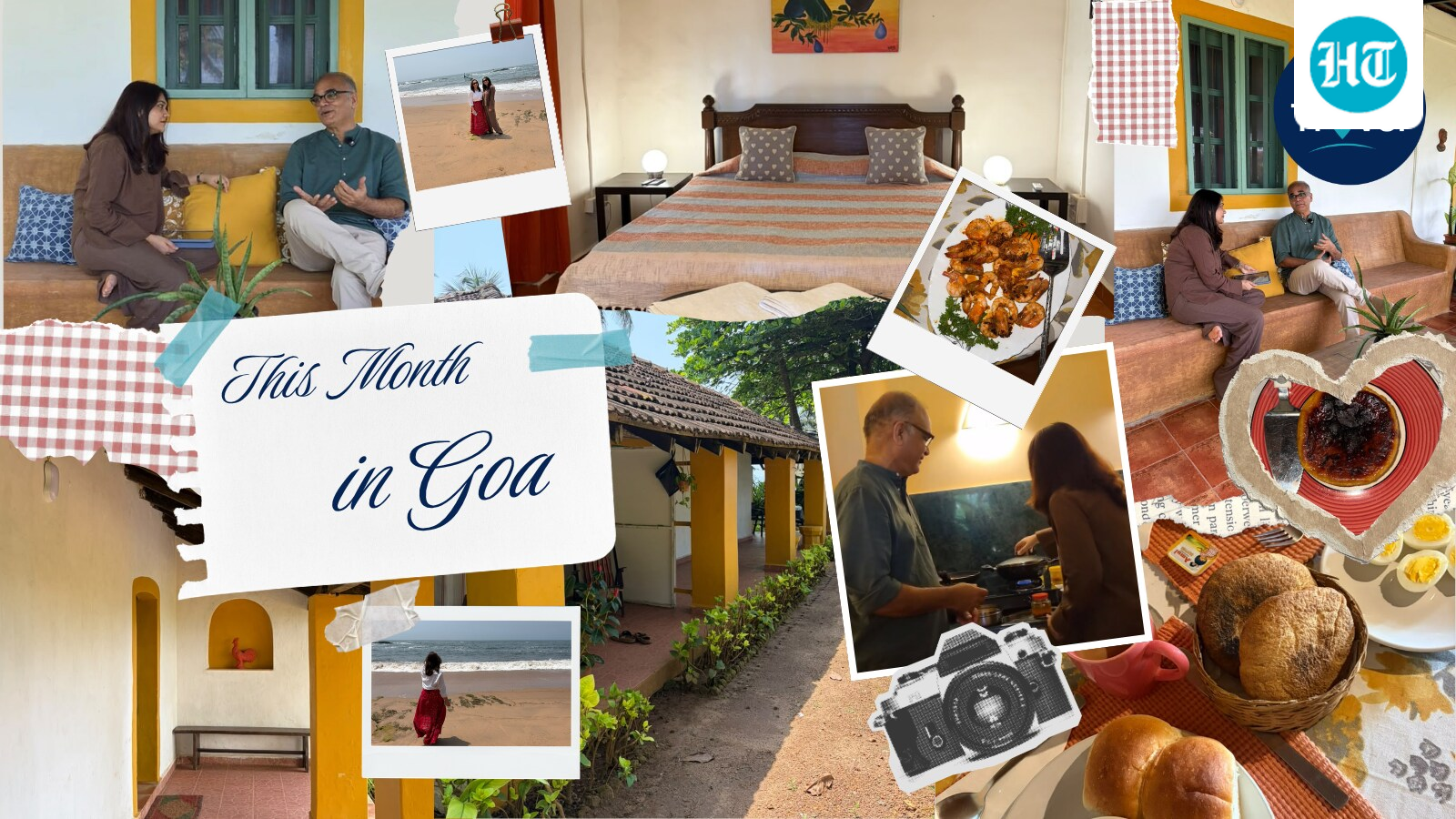
I reached Anjuna at 3 am after a terribly delayed flight and, by the time I finally got into bed at Sobit, one of Cezar Pinto’s cottages in South Anjuna, I had already accepted that the next morning was going to be rough. I had barely four hours before I needed to wake up again. Strangely, at 7 am, I felt rested. I think it was the ocean. You can hear the Arabian Sea from the cottage, not as an overpowering roar but as a constant rhythm somewhere behind everything else. Through the night, those waves became almost like white noise for a very disturbed, very tired mind. Four hours of sleep had absolutely no business feeling that good, but somehow they did.
Later that morning, I sat down with Cezar Pinto with the ocean providing our background music. Our conversation started slowly and stayed wonderfully relaxed, much like Cezar himself. At 65, he is a lifelong Goan, furniture designer, heritage enthusiast and Airbnb host who has spent 27 years working with furniture and design. He previously ran Casa Goa, a lifestyle store inside an old Goan home in Calangute, where furniture, art, clothing and design objects came together to give visitors a sense of traditional Goan living. Today, he continues his furniture work, is involved with a local group working to protect Goa’s heritage and hosts guests across two inherited properties in Anjuna.
Those are the facts about Cezar. Sitting across from him tells you much more. Here was a man who had seen Goa in so many seasons and through so many phases that I kept thinking his stories could fill a book. He spoke about Goa in the 1960s, the hippie movement, full moon parties, the flea market, Goa trance and the Goa of today, but what struck me most was what was missing from the conversation. There was no agitation about development and no insistence that everything had been better before tourism arrived in such enormous numbers. Instead, there was wonder at what his home state had become and a quiet amusement at how much had changed within his own lifetime.
When Anjuna was boring
Cezar spent his childhood summers in Anjuna, but his memories are not quite the dreamy childhood by the sea story you might expect. “We used to hate coming to Goa because it was so boring,” he laughed. “There was nothing happening.” His family would come here for the summer holidays when Anjuna was remarkably quiet and had little of the activity associated with it today. For anyone who has recently sat in Anjuna traffic or tried getting a table at a popular restaurant on a Saturday evening, the thought of children complaining that nothing happened here feels almost absurd.
Things began changing in the late 1960s when the hippie movement arrived. Cezar remembers full moon parties beginning and travellers staying in the area for months at a time. He spoke about 8 Finger Eddie and the origins of the Anjuna flea market, recalling how travellers running short of money towards the end of their time in India would sell belongings and imported goods before leaving. Foreign products were difficult to find in India then, and what began as a practical exchange gradually became part of Anjuna’s identity. He also remembers people connected with the early party scene renting spaces in the area and spoke about Raja Ram and the growth of Goa trance.
What I loved was listening to Cezar laugh about being the little boy who did not want to spend his summer holidays here. Today, Anjuna is deeply connected to his voice, work and life. The family weekend home that once represented those boring holidays has become something he loves sharing with other people. There is something wonderfully circular about that.
A family home that became his Airbnb child
Cezar has been hosting on Airbnb for nine years. Before that, the family rented spaces to people who would sometimes stay for three months at a stretch. Eventually, he felt that the arrangement no longer worked for him and began looking at a different way of hosting. Airbnb entered the story at that point and today remains the only hosting platform he uses, alongside direct bookings.
Hosting is not his primary source of income, and Cezar knows how competitive Goa’s accommodation market has become. Yet there is obvious joy in the way he talks about having people stay here. I started thinking of Sobit almost as his Airbnb child, a family space he has watched take on another life while still keeping its original connection to Anjuna. Modern comforts have been added, but the cottage does not feel stripped of its Goan identity in the process.
For me, its greatest luxury was its location. You can walk towards Anjuna from behind the cottages, and the sea is close enough to remain part of your day. At the same time, you can come back, crawl into bed and feel secluded from all the noise that usually accompanies North Goa. That combination stayed with me. Goa is outside when you want it, but you can shut the door when you have had enough.
Somewhere between the conversation, we started cooking
Our conversation eventually moved from the sitting area into the kitchen, and Cezar and I started cooking together while we continued talking. It felt completely natural, which perhaps says more about his style of hospitality than anything else I could write. Soon there was ros omelette, peri peri prawns with feni and poee on the table. The prawns were fiery with chilli and garlic, while the feni gave the preparation a distinctly Goan character. The ros omelette came with the rich gravy that turns something as simple as an omelette into one of Goa’s most satisfying street food meals.
Cezar believes ros omelette is one of the local dishes visitors should try beyond the familiar conversations around poee. He laughed about how something that began as street food now appears in increasingly polished versions at restaurants. Our wider culinary experience also included bebinca, batica and kokum soda, each bringing another part of Goa’s food culture to the table. I am saving those recipes for another story because there is far too much to say about them in a few lines.
That brunch was one of my favourite parts of the stay. Not because it was elaborate, but because the food belonged to the conversation we were having. We were talking about Goa while cooking Goan food in a Goan home, with the sea still audible outside. There was no need to manufacture a sense of place. It was already there.
Look beyond the beach, and Goa starts telling another story
When I asked Cezar where he would send someone who had only one day in Goa and wanted to move beyond the standard tourist circuit, he did not name a beach. He suggested walking through Fontainhas in Panjim. For him, its streets, homes, restaurants and architecture offer a way to understand another side of Goa, one that can get lost when a trip revolves entirely around the coastline.
His design background becomes particularly apparent when the conversation turns to architecture. Cezar is careful about calling Goa’s historic homes simply Portuguese architecture. Portuguese influence is unquestionably part of their history, he explained, but local Goan craftspeople built these spaces and brought Indian ideas and craftsmanship into them. For him, Indo-Portuguese architecture is a far more accurate description.
That distinction also explains a lot about Cezar’s own work. Casa Goa, his former lifestyle store, operated from an old Goan home in Calangute, while the properties he hosts today continue his relationship with older spaces. His interest in heritage is not about keeping a home frozen in another decade. He wants these buildings to continue being used and lived in without losing everything that made them Goan in the first place.
If you stay in someone’s home, remember that it is still their home
For someone so relaxed in conversation, Cezar became very clear when I asked what he wished travellers understood about staying in someone else’s property. Respect the home as you would your own. Respect the surroundings and the neighbours too. It sounds basic, but in a destination receiving visitors throughout the year, the small things matter.
Water, in particular, is becoming an issue in coastal villages, and he would like guests to remain conscious of how much they use. The same applies to electricity and leaving air conditioning running unnecessarily. Most guests, he says, are sensitive to these things once they understand the local context. It was also a useful reminder for me that the things we treat as unlimited during a holiday are still local resources long after we check out.
Goa’s traditional tourism calendar is changing too. The monsoon months once created a much clearer quiet season between June and September, but Cezar says that gap is getting shorter. For hosts, those relatively calmer weeks are valuable because traditional properties constantly need work. Repairs and maintenance that are difficult during continuous bookings are prioritised whenever a free week appears. A heritage home may look wonderfully effortless when you arrive, but keeping it that way is anything but.
Cezar’s Goa recommendations
After listening to someone talk about Goa across six decades, I obviously could not leave without asking where he actually goes himself.
- For a quiet beach: Galjibag in South Goa, a turtle nesting beach that Cezar loves for its relative calm.
- For a beachside meal: Pousada by the Beach.
- For a special meal: Black Sheep Bistro.
- For a local fish thali: Tukaram in Mapusa, a spot Cezar described as tucked away. He laughed immediately after telling me about it because, well, now we all know.
- For a taste of Goa beyond its beaches: Walk through Fontainhas in Panjim and pay attention to the homes, streets and food around you.
- For one local dish: Ros omelette, preferably followed by enough poee to mop up every bit of ros left on the plate.
Sobit means beautiful
Cezar told us that Sobit means beautiful. By the time I left, I could not think of a more fitting name for the experience. Not because this was some secret Goa untouched by tourism. It is Anjuna. People from across the world know it, visit it and return to it. The quiet village Cezar remembers from childhood has changed beyond recognition.
What I found beautiful was that quiet had not completely disappeared. I could walk out from behind the cottage and head towards Anjuna, then come back and retreat into a room where the ocean once again became the loudest thing I could hear. I could sit with someone who remembered this neighbourhood before it became one of Goa’s most famous addresses, cook ros omelette and feni-laced prawns with him, and hear about all the versions of Goa he had lived through without once hearing him complain that the old one had been better.
I had described to Cezar that sitting here was a “washing machine detox” for the brain. It made him laugh when I said it, but after arriving at 3 am with a tired, overstimulated mind and waking four hours later feeling strangely refreshed, I understood exactly what sound therapy meant. For all the things we now expect Goa to give us, sometimes the best thing it can offer is remarkably simple. A bed, a Goan home and the sound of the sea outside.
Similar articles for you
I spent a week in Hong Kong in November. Here’s how to plan your 2026 trip
I went to Chandigarh to learn golf and came back with a new way to holiday; Golf-cation decoded
I stopped folding my clothes while packing, and my suitcase suddenly had a lot more space
I fly often, and these are the handbag essentials that make long flights and layovers easier
