

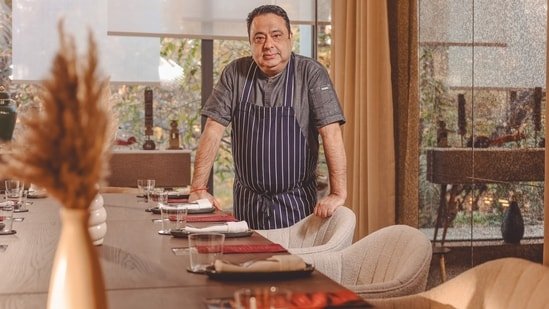
Born into a vegetarian household where even onion and garlic were off-limits, Manish Mehrotra seemed an unlikely candidate to spark a global culinary revolution. Yet, the celebrity chef went on to dismantle the boundaries of Indian cuisine, birthing the popular Indian Accent and its avant-garde approach to fine dining. Now, Mehrotra is on a mission to disrupt his own legacy. He’s wiping it all away to redefine ‘fine dining’ as something more inclusive and non-intimidating.
In an interview with Hindustan Times, Mehrotra talks about the new path of his career with new venture, Nisaba, his culinary journey, the Lakshman rekha that chefs should not forget and the biggest myths about Indian food that continue to exist.
On his culinary journey
For Mehrotra, growing up in a traditional vegetarian household sparked his fascination with food, inspiring him to explore the culinary world, and the rest is history.
“It was a vegetarian household, mostly no onion and no garlic. My father didn’t eat onions and garlic. That really taught me that even food which is vegetarian and without onion and garlic can be delicious. You don’t need hundreds of things to make it delicious,” confesses Mehrotra.
He continues, “And the best part was the support of the family. My parents never stopped us from eating it outside. We could eat whatever we wanted to, experiment. They never said, ‘You have to be a vegetarian because I’m a vegetarian’. That is why I could join a hotel school. It’s been 30 years since I have been in the kitchen.”
On walking on a new path
Over these 30 years, Mehrotra found global acclaim with Indian Accent, and also made a mark in the international culinary scene with pan-Asian cuisine. It was in 2024 when the news of Mehrotra departing Indian Accent slipped out, following which the celebrated chef took a year-long hiatus to reflect, reset, and rediscover his calling.
“I have worked for 30 years in hotels and restaurants, and I wanted a break. I took that one-year break when I left Indian Accent and Comorin in 2024…It was a very difficult decision because both were my babies. It’s not that they were running, and I joined. I started it. So it was a tough decision, but it was time for me to move on and take a break,” Mehrotra tells us as we sit inside his new culinary venture, tucked away on the first floor of the Humayun’s Tomb Museum within the serene surroundings of Sunder Nursery.
He adds, “During that time, I thought of opening a place where I can do simple, non-intimidating soulful Indian food in a beautiful setting.”
On mission to break away from fine dining
It was during this pause that inspiration struck Mehrotra, leading to the birth of his new venture, Nisaba – a concept that reflects his deep-rooted love for India’s street food culture and his flair for reimagining it with playful sophistication.
“I was the one who started the term ‘modern Indian food’. Now, I feel Indian food has become modern. So why do we have to call it modern Indian food? Now, it is time to present your interpretation of Indian food. Now, people have become more adventurous. Their palate has evolved. They know about regions and are open to experimenting with them,” says the chef with excitement in his voice.
This creative approach shines through the menu, where familiar favourites are elevated with unexpected twists: baby samosas are served floating on a comforting pool of Moradabadi dal dusted with churan-like buknu masala; mutton seekh kebabs arrive paired with indulgent blue cheese butter and baked naan; the rustic Motihari mutton curry is presented in a traditional clay pot; and even the humble fryums are transformed into a nostalgic accompaniment that sparks childhood memories with every bite. Mehrotra has also introduced a private dining experience with The Times of India Heritage Table at the restaurant, designed for intimate gatherings.
“In 2026, the world is moving towards comfortable dining over fine dining, something which I have tried to do with my new venture. It is not super luxurious, but luxurious. You feel you are eating in a comfortable environment, like your drawing room. The food is not stiff, not intimidating. It is not decided by someone else to plan a tasting menu. And that is what the world is moving towards,” Mehrotra says.
On viral food trends
As the conversation turns to the food landscape of 2026, it’s impossible to ignore the wave of culinary trends that constantly emerge and go viral across social media platforms. Here, Mehrotra emphasises that chefs today need to practise a sense of restraint.
“Like, recently, there was a trend of dosa ice-cream. But these things will come and go. The person who is making it might not eat it. There is no denying that they do go viral. But every chef who is now doing Indian food needs to have some kind of guidelines or a Lakshman Rekha in his/her thinking… That these are my rules, and I’m not going to cross them. Whether you call it fusion or whatever, the main thing is that people will only like it if there is a reason behind it,” Mehrotra shares.
On myths about Indian food
Here, Mehrotra points out one of the biggest myths that continues to surround Indian cuisine, expressing hope that this misconception will soon be put to rest.
“Chicken tikka masala. That’s the biggest myth of India. One of the biggest myths of Indian food is that it is only about curry or that Indian food is only about big pots of everything,” Mehrotra rues.
He continues, “India makes one of the best pancakes in the world, which the world knows as dosa. India has food for every palate in the world. We celebrate food from the moment a child is born. In fact, in most cultures, we send people off with food. So, from birth till death, food is being celebrated… Every country celebrates food, but the way and how diversely we celebrate food is amazing.”
