

One night last month, I think I had a melatonin-triggered dream (melatonin being notorious for inducing vivid, cinematic dreams) in which Bob Weir, with his wild white beard and thick moustache, sat on a high stool in the centre of a dark stage with a gentle spotlight bathing him in golden light. He was alone with just an acoustic guitar, singing an incredibly slowed-down version of Grateful Dead’s West LA Fadeaway.
The dream was happy and soothing. Two days later, news broke of Weir’s death, aged 78. The dream turned out to be sadly prescient.
A few days later, I watched his hometown San Francisco’s touching farewell live on YouTube. It got me thinking about the other living legends of music that have been part of our lives for more than half a century, and how fortunate we are that some continue to perform and record as Weir did. Those thoughts were tinged with sadness. They are all in the twilight of their lives.
Willie Nelson, at 92, remains an astonishing force of nature. The country-music icon continues to tour with Outlaw Music Festival, still sleeping on his tour bus between shows as he has done for decades. There is something almost mythical about the way he picks up that guitar night after night. This year, there are whispers of a tour titled One Last Ride, though with Willie, one can always still hope there will be more.
Of the surviving Beatles, Ringo Starr, 85, is still on the road with his All-Starr Band, spreading his message of peace and love with the same gentle insistence. Paul McCartney, 83, continues to tour extensively, delivering timeless classics to massive crowds. I saw footage of a recent concert at which he played for nearly three hours, with an audience spanning generations hanging on every word.
Bob Dylan, 84, the Nobel laureate and eternal enigma, maintains an active touring schedule. Last year he touched down in Helsinki, where I live, and thousands stood in the sold-out arena, listening to that sandpaper voice reshape songs they thought they knew.
The Rolling Stones, those adorable reprobates, continue to defy every natural law. Mick Jagger, at 82, performs with the energy of someone a third his age, especially following the success of his 2023 album Hackney Diamonds. The memes about Keith Richards, also 82, are legion. How has a man who lived so hard outlasted everyone? (Perhaps rock-and-roll actually preserves rather than “destroys”.)
The jazz world has its enduring titans. Marshall Allen, 101, saxophonist and leader of the Sun Ra Arkestra, made history in 2024 when he released his debut solo album just after his 100th birthday; he continues to perform. Herbie Hancock, at 85, remains remarkably active, still touring and teaching at the Herbie Hancock Institute of Jazz Performance at University of California, Los Angeles.
The legendary bassist Ron Carter holds the Guinness world record for most-recorded jazz bassist, with over 2,200 albums. He marked his 88th birthday last year with six nights at the Blue Note in New York.
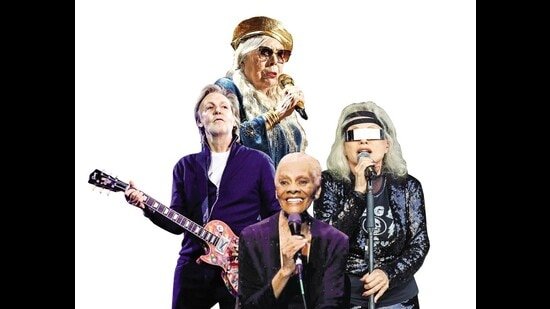
Dionne Warwick continues to tour, at 85, her poise and elegance unchanged. Herb Alpert maintains an active performance schedule, at 90. There are others: Buddy Guy, the 89-year-old blues legend whose guitar influenced everyone from Hendrix to Clapton; Smokey Robinson, 86 in a few days, the Motown colossus whom Bob Dylan described as “America’s greatest living poet”; Debbie Harry, the iconic Blondie frontwoman, who still performs live at 80.
In their late-70s, we have another constellation of stars refusing to dim: Elton John, 78, retired from touring in 2023 but still makes special appearances; the redoubtable godfather of punk, Iggy Pop, at 78, not only performs live regularly but also DJs a must-listen weekly show on BBC Radio 6; Alice Cooper, 78, continues his theatrical shows, which remain as mind-blowing as ever.
Robert Plant, 77, hasn’t stopped evolving his musical style and performs with his folk-focused outfit, Saving Grace — not clinging to the past but moving through it, reshaping his relationship with Led Zeppelin’s legendary songs. Jimmy Page, 82, has been more selective about appearances, focusing on archival projects and curating the Zeppelin legacy with meticulous care. Joni Mitchell, also 82, suffered a brain aneurysm in 2015 and was told she might never perform again, but has returned to the stage. Watching her sing Both Sides Now at Newport Folk Festival 2022 was unspeakably moving.
Neil Young, at 80, continues to perform with Crazy Horse and remains an active, combative presence in music. As does Chrissie Hynde, 74, of The Pretenders, who famously said: “You never retire. You become relentless.” For these artists, music isn’t a career; it’s life itself.
Cher, 79, and Dolly Parton, 80, both icons, continue to perform, create and remain relevant across generations. Joan Baez, 85, the voice of protest and conscience from the 1960s, makes occasional performances, her voice still unmistakeable.
A caveat would be appropriate here: this is hardly an exhaustive list; it is a personal one. What strikes me most about this remarkable cohort is not just their longevity but their refusal to become nostalgia acts, museum pieces performing greatest hits by rote. Many continue to create, experiment and challenge themselves and their audiences. They understand something essential: Art doesn’t stop you aging, but it gives aging meaning.
We are living through a unique moment in musical history. Never before have we had so many artists from a single generation — in this case, the generation that revolutionised popular music in the 1960s and ’70s — still active and performing in their 80s and 90s.
It can’t last forever. The actuarial tables are unforgiving. But for now, while we have them, perhaps the best thing to do is what they’ve always asked of us: Listen. Really listen. Buy the tickets, stream the concerts, absorb the new albums. They’ve given us the soundtrack to our lives. The least we can do is pay attention while they’re still playing.
